AI music detectors vs. VERA
An AI music detector estimates how likely a track is to be AI. VERA™ finds the mark a specific generator leaves in the audio and shows it to you.
Published · Updated
Most AI music detectors work the same way. You upload a track. You get a number back, like "64% likely AI".
That number helps when you have ten thousand tracks to sort. It's harder to stand behind when one track has a decision riding on it. Say you hold a payout and the artist asks how you know. "The tool said 64%" is a hard answer to give.
With VERA you open the report instead. Here's the pattern this generator leaves in its audio. Here it is in the vocals of your track. Look where the peaks land.
A probability tells you what a model concluded.
A measurement tells you what is in the audio.
How is VERA different from an AI music detector?
An AI music detector is a neural network or similar classifier trained on example tracks. It estimates how likely a new track is to be AI. VERA, by Oddtune, is a verification tool. It runs many advanced measurement methods we built ourselves, each aimed at one known pattern a specific AI generator leaves in its audio. When it finds one, it shows you that pattern drawn over the generator's reference.
A detector learns by example. It's trained on songs from the generators it should recognize, until it picks up what sets them apart from human-made music. As far as we know, every AI music detector on the market works this way. That makes it strongest on music like its examples. When a new generator or version comes out, the model has to be retrained to keep up. And what it noticed stays inside the model. You only see the score.
VERA starts somewhere else. Think of a seam. Hand stitches are never quite even. A sewing machine puts every stitch at exactly the same length, whatever the fabric. You can't always tell by looking. Hold a ruler to it and you can.
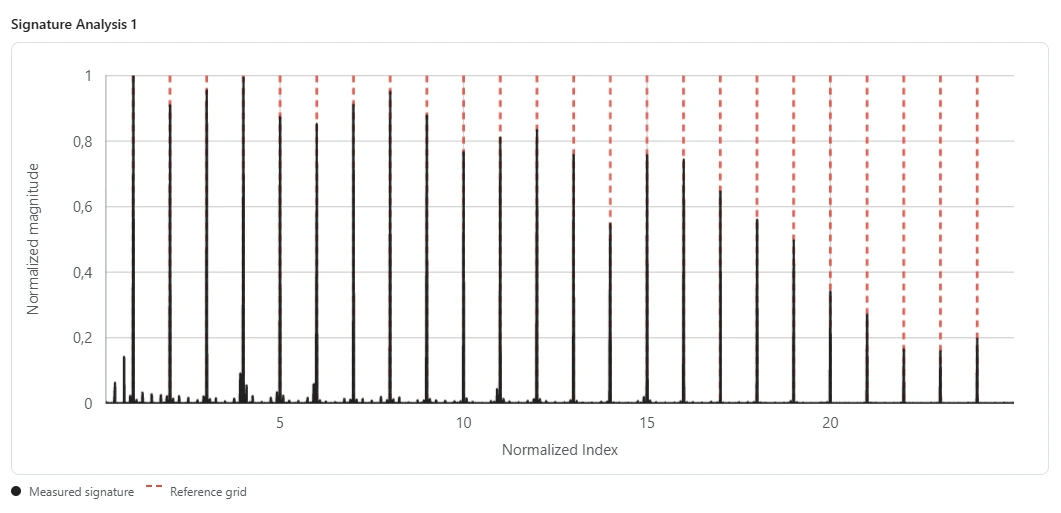
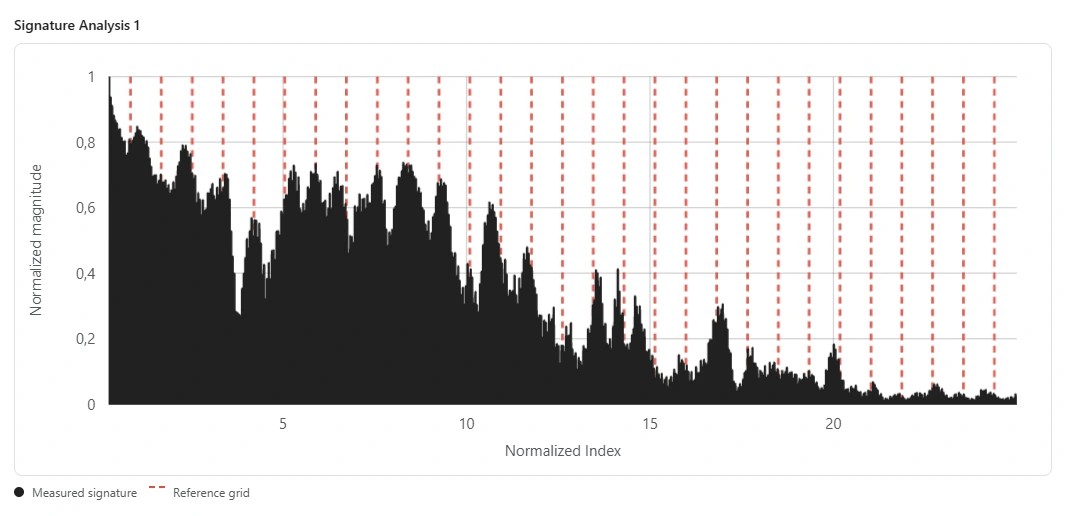
AI music has a seam like that. A generator doesn't play anything. It builds the audio on a fixed grid, in tiny equal steps, many per second. That grid leaves a faint row of evenly spaced peaks in the sound. You can't hear it, but you can measure it. The spacing is the same in every song the generator makes, whatever the genre or key.
Voices and instruments make patterns too, but theirs move with every note. A generator's pattern stays put, and each generator has its own spacing. That's how VERA can name the generator instead of just saying "AI".
VERA's ruler is the reference for each generator. The report draws the pattern from your track over it. The peaks either land on the marks or they don't.
A generated track
A human-made recording
VERA also checks the vocals, the drums and the rest of the mix one at a time. A generated vocal over a live band shows up in the vocals instead of getting lost in the full mix.
VERA and AI music detectors, side by side
| AI music detectors | VERA | |
|---|---|---|
| When someone asks how you know | "A model scored the track 64%." | "Here's the generator's pattern in this track, drawn over its reference." |
| The question it answers | Does this track resemble the AI music the model learned from? | Is a specific generator's pattern in this recording? |
| How it works | A neural network or similar classifier, trained on example tracks | Measurement methods built to find the known pattern each generator leaves |
| What you get | One percentage for the track | The matching generator, how closely it matched, and the plot behind both |
| Tracks that are part AI | One reading for the whole mix | Vocals, drums and the rest checked one by one |
| When the generator is updated | The model is retrained on new examples, and results change with it | The pattern comes from how the generator builds sound, so it holds |
| Best at | Sorting a lot of audio quickly | Single tracks where a decision has to hold, like charts, payouts, licensing and appeals |
| What you keep | A score, sometimes a heatmap | A report on screen or as a PDF, with the plots and checks behind every finding |
Detectors vary. This describes the approach most of them share.
How accurate is VERA?
Accuracy grades a tool that predicts. You test it on tracks where the answers are known and count how often it was right. If you're choosing between detectors, ask for that number.
Think of a forecast next to a thermometer. A forecast says 80% chance of rain. You trust it because it's been right most of the season. A thermometer says 14 degrees. You trust it because you can read it and it's calibrated. Both are useful. One is an estimate, the other is a reading.
VERA is the thermometer. It takes the same fixed measurements on every track. There's no hit rate to publish, just the reading. Each finding shows the pattern next to its reference, the checks that ran and how closely it matched. Checking the result means looking at it.
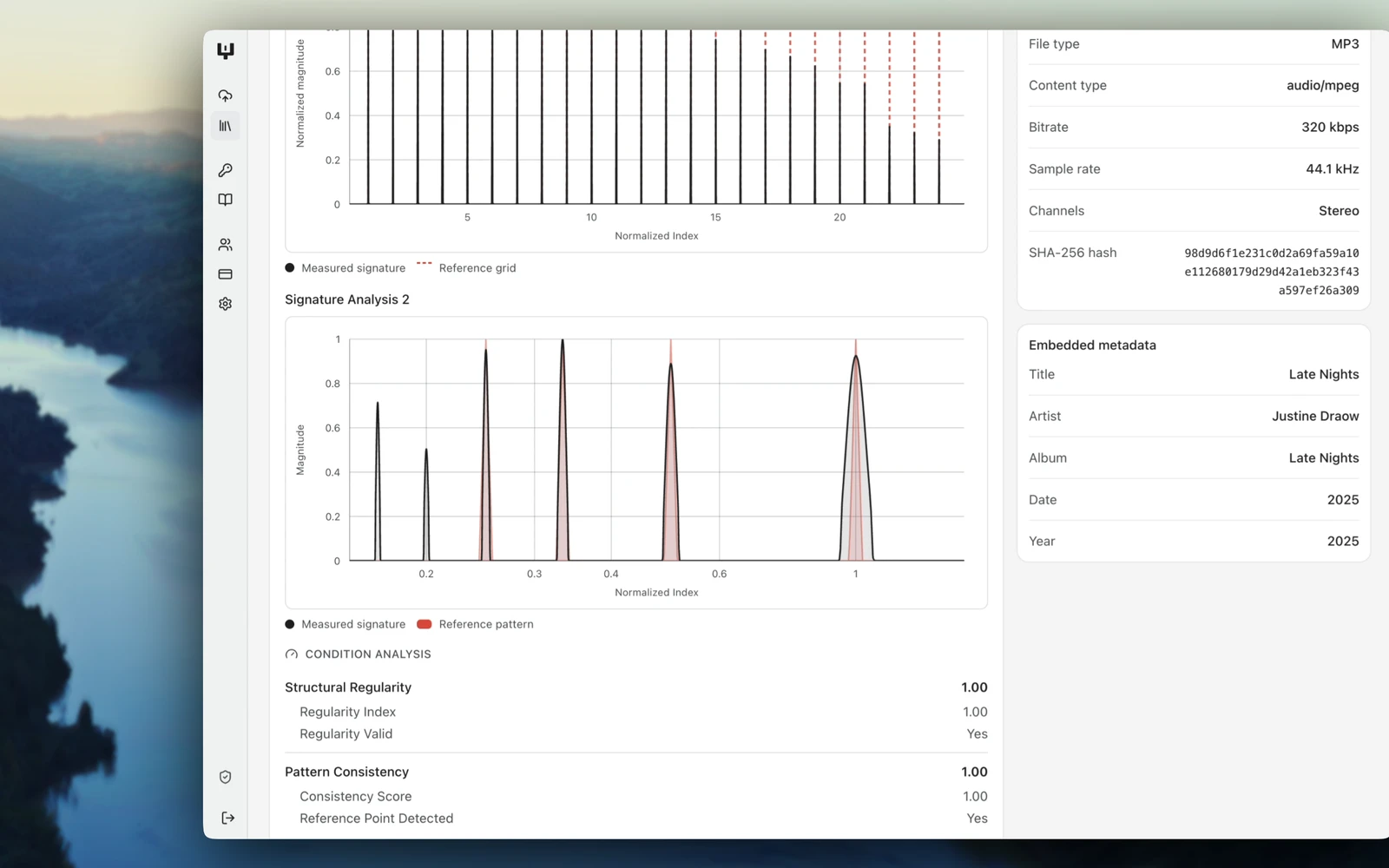
More on how the measurements work is in the FAQ.
What a finding tells you, and what it doesn't
A VERA finding answers one question. Is this generator's pattern in this recording? Either it is or it isn't, and you can look for yourself.
A second question sits behind it. How did the pattern get there? No measurement of a file can answer that. The people who made the track can. Almost always the answer is the obvious one. The audio came out of that generator.
What the measurement answers
- Which generator's pattern is in the track
- Which part of the mix carries it: the vocals, the drums or the rest
- How closely it matched, and how that looks on the plot
What stays open
- How the pattern got into the file
- What the right call is for this track
What if a human-made track gets flagged?
For a tool that estimates, a false positive is simple. The estimate was wrong. VERA doesn't estimate. So if a track people believe is human-made comes back flagged, the pattern really is in the file. The open question is how it got there.
A few honest explanations fit. The track may hold more generated material than anyone involved knew. Or the audio went through a generator at some point, for example a remaster tool that re-generates the sound. That leaves the pattern even when people wrote and played the song. Or it's a case we haven't seen yet, and we want to look at it.
We could argue that a correctly measured pattern is a correct result. We don't. A wrong flag lands on a real artist, so this is the number we watch hardest. Every flagged track we can't explain stays in the count. That makes our published figure a ceiling, not a rate. Across a large reference set of human-made music, fewer than 0.04% of tracks came back flagged. In customer use so far there are zero confirmed false positives.
A finding is not an accusation. It's a reading. What it means for a track is for the people involved to decide, with the evidence in front of them.
With a score, a dispute turns into an argument about the tool. With a measurement, everyone looks at the same plot of the same file. That conversation can actually end.
When a detector is the right tool
Sometimes you need a quick read on a lot of audio, so a person knows where to look first. A detector is built for that, and it does it well.
Keep the detector you have. Many teams run both. The detector finds the tracks worth a closer look. VERA is for the one track that needs an answer you can show someone.
Questions people ask
Is VERA™ an AI music detector?
Not in the usual sense. As far as we know, every AI music detector on the market today is a classifier. They estimate a probability, usually from a model trained on a lot of audio, and usually across the whole mix at once. VERA is a verification tool, built from measurement methods we made ourselves. We separate the stems, check each one for the known pattern a specific generator leaves behind, and plot what we found against the reference for that generator. There is a number in the report as well, but it measures how closely your track matches that reference, not how likely it is to be AI.
What is the best AI music detector?
That depends on what you will do with the answer. If you need a quick read on a lot of audio, so a person knows where to look first, a detector that gives a score is built for that. If the answer decides a payout or an appeal, you need a result you can show someone. Reliable means something different for each. A score is reliable if it is usually right. A finding is reliable if it still stands when someone questions it. A few questions help you choose. Does it name the generator, or only say "AI"? Does it check the vocals, the drums and the rest of the mix one at a time? What happens when a generator is updated? And when an artist asks how you know, what do you open? VERA™, by Oddtune, is built for the second kind of decision. It is a verification tool rather than a detector. It names the generator and shows its pattern in your track, drawn over that generator's reference. Many teams run both.
What does VERA™ actually measure in a track?
The structure of the audio itself. AI generators build sound on a fixed grid of tiny, equal steps. That grid leaves an evenly spaced pattern in the signal, the same in every song a generator makes. Human recordings are naturally uneven and carry no such pattern. We read it straight from the file, whatever the genre or style.
Can VERA™ distinguish fully AI-generated tracks from partially AI-generated ones?
Yes. A track-level result covers the fully generated case, and stem separation covers the partial ones. We split the recording into stem groups (vocals, drums or other) and trace the evidence back to whichever one carries it, so you can see which side of the mix the AI is on. Vocals over human production is the obvious case, and it is also the one a whole-mix tool is most likely to let through. One generated part inside an otherwise human-made mix gets diluted by everything around it. Separating first keeps it legible. We validated the separation method for this purpose, because it has to be calibrated to the measurement for the evidence to hold. Broader AI-assisted workflows, such as AI-aided composition rendered through human production, sit outside what we report today.
Does VERA™ work if the AI model is updated or fine-tuned?
Yes. The signatures we measure come from a generator's core architecture, not its trained weights. Fine-tuning or retraining on new data changes the weights, not the architecture, so the traces stay put and the evidence holds.
What does it mean if a track comes back without a match?
It means none of the signatures we measure for turned up in that file. A few things can hide one even when a generator was used. A generated part can sit low in the mix under real instruments, too quiet to read. Heavy effects like chorus or phaser smear the structure we measure, and significant pitch shifting moves it. Splitting the stems catches most of that, but something quiet enough can still sit under the floor. So when we come back with a generator, you can rely on it. When we come back with nothing, the honest word is inconclusive, not clean.
How accurate is VERA™?
Accuracy percentages are a machine-learning measure of how often a model's predictions matched a labeled test set. We measure the recording rather than predicting from it, so the question is different. Is a known generator pattern present in this audio, and can you see it? Every result comes with the measured signature plotted against the reference it was compared with. The figure we watch hardest is how often authentic music gets flagged, because a wrong flag lands on a real creator. Across a large reference set of human-made music, fewer than 0.04% of tracks came back flagged. Read that as a ceiling, not a rate. In customer use to date there are zero confirmed false positives.